Artificial Intelligence
The SaaS Reckoning: Lessons from Guru

Introduction
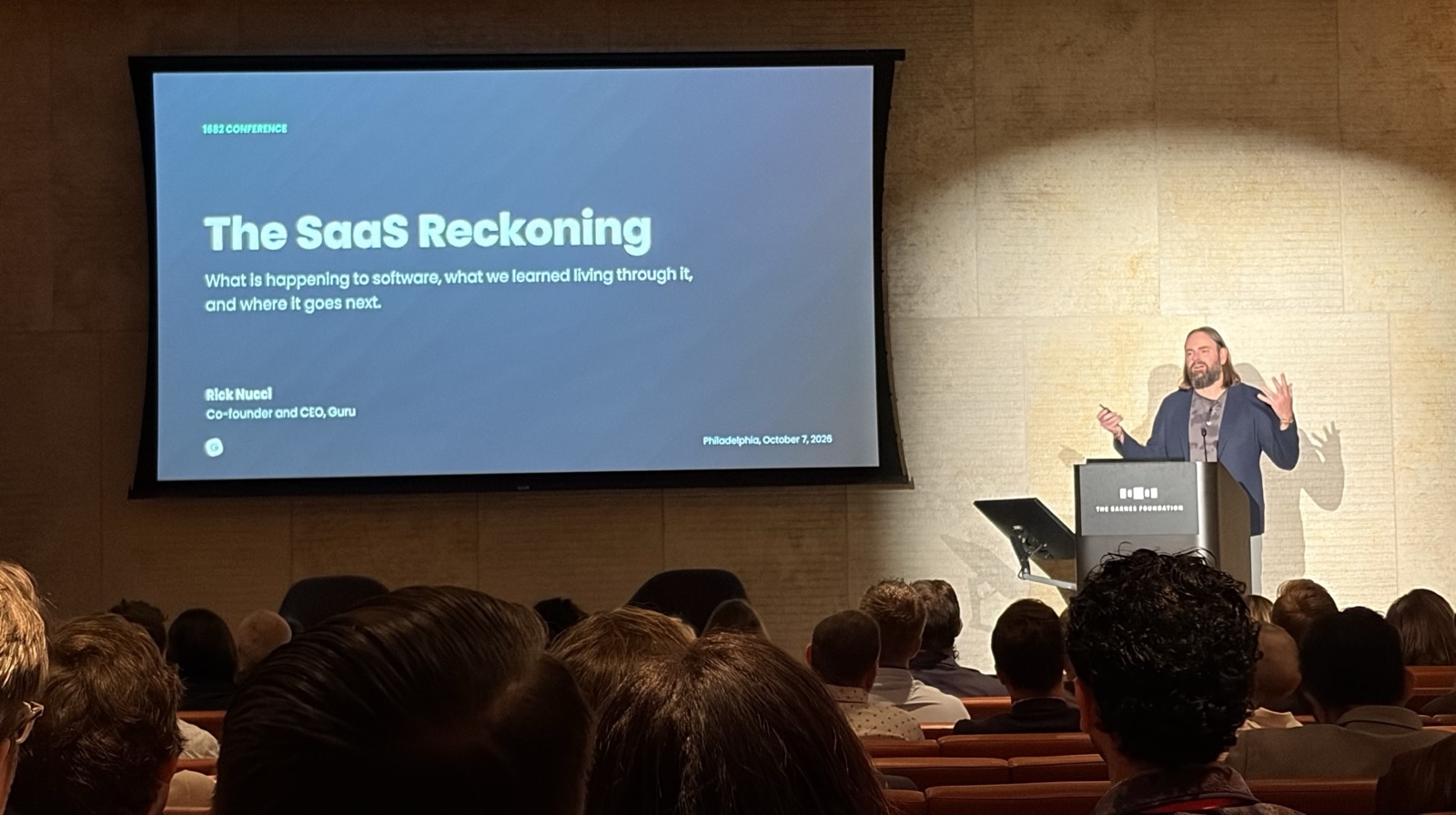
On October 7, I attended 1682 , O3 World’s business of innovation conference at the Barnes Foundation in Philadelphia.
This year’s theme was “AI for All of Us” and one of the sessions I enjoyed the most was “The SaaS reckoning: knowledge, agents, and the future of work” by Rick Nucci, co-founder and CEO of Guru .
In this article, I’ll share Rick’s five lessons from rebuilding Guru for AI, what he thinks comes next, and where I think his points apply to companies rolling out AI today.
Accuracy, Not Access
Rick started with the question every founder asks themselves (and every good VC asks every founder):
“Why now?”
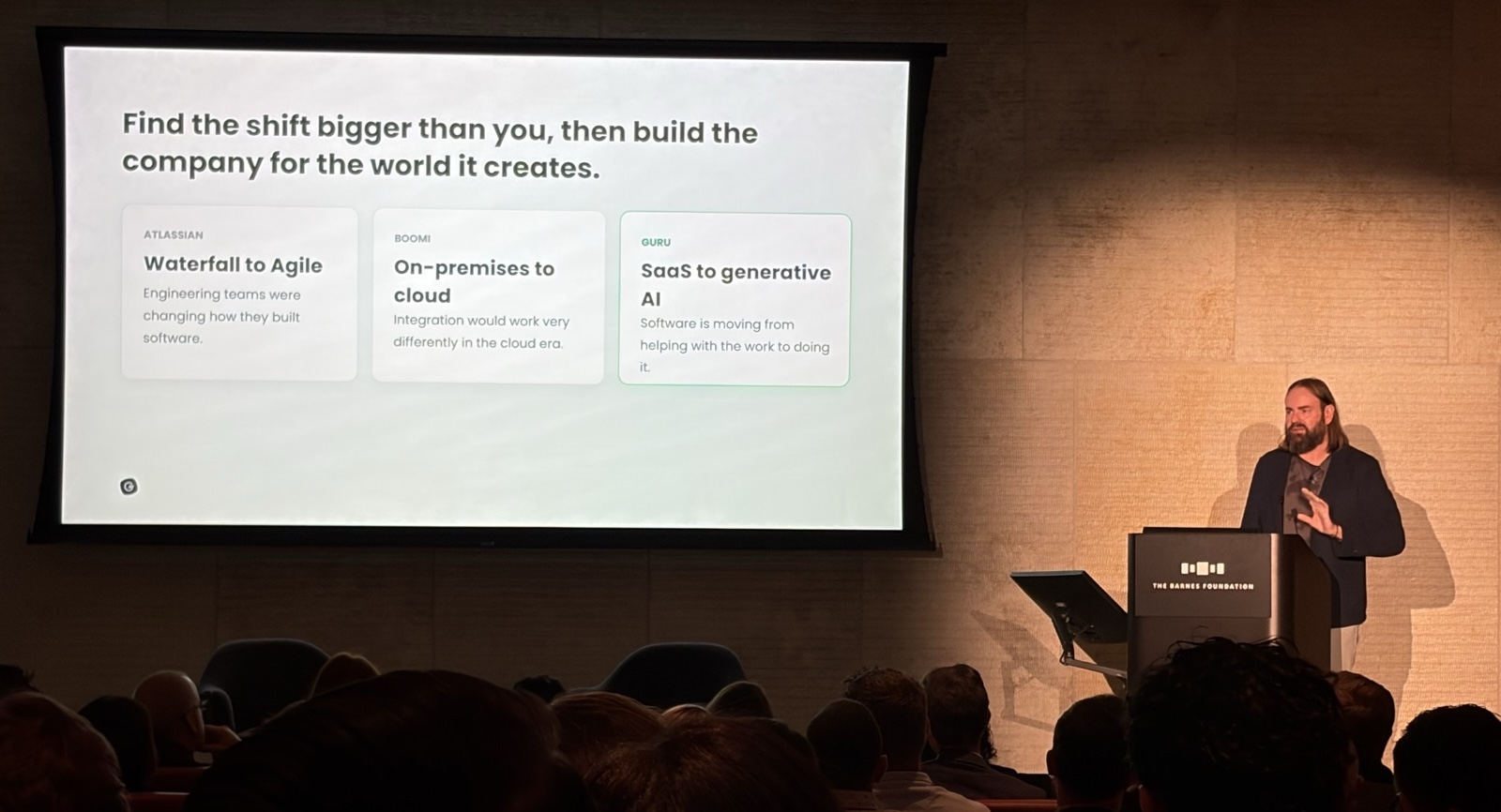
For Atlassian, the why now was the industry moving from waterfall to agile, which led to Jira. For Boomi, it was companies adopting Salesforce, NetSuite, and Marketo, which meant integrating those systems was going to look very different.
For Guru, it was the ChatGPT moment in November 2022.
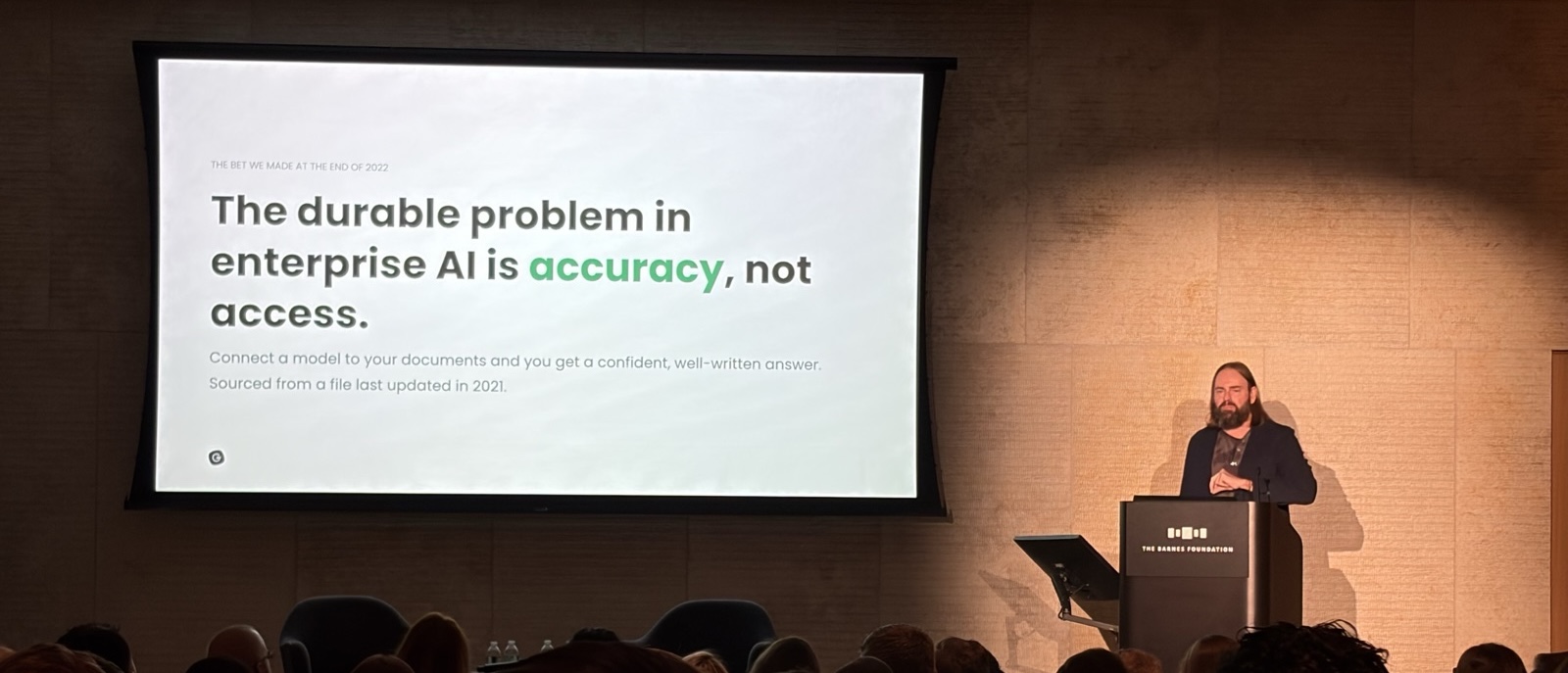
At their December leadership offsite, going into 2023, the team decided that the durable problem in enterprise AI was going to be accuracy, not access.
Models know nothing about your company: your people, your products, your processes, how you sell and how you support what you sell.
That know-how (what most people now call context) has to be available and useful to an AI system before it can do any real work. When it’s missing, the model won’t tell you it doesn’t know. It will give you a very confident answer that happens to be wrong.
Access is the opposite assumption: “All my stuff is already in Google Drive, I’ll just point the AI at it.”
Rick’s example was hooking an AI straight into SharePoint and having it tell you how you price your product, based on a document from 2021.
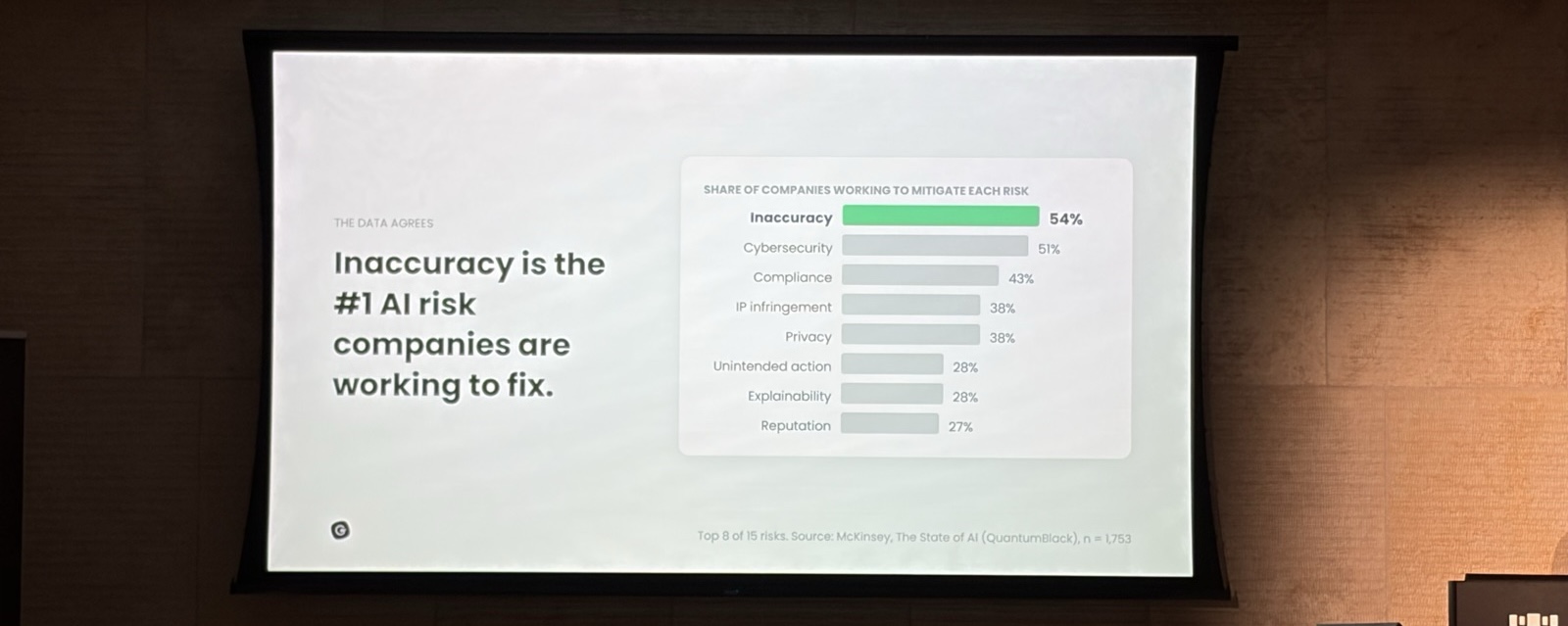
He also shared data from McKinsey’s State of AI survey: inaccuracy is the risk the largest share of companies are working to mitigate (54%), slightly ahead of cybersecurity (51%).
To explain the difference, he used an analogy built for a Philadelphia crowd: you don’t fill up a bucket in the Schuylkill River and serve it to your family.
Water goes through a treatment plant before it gets to your faucet.
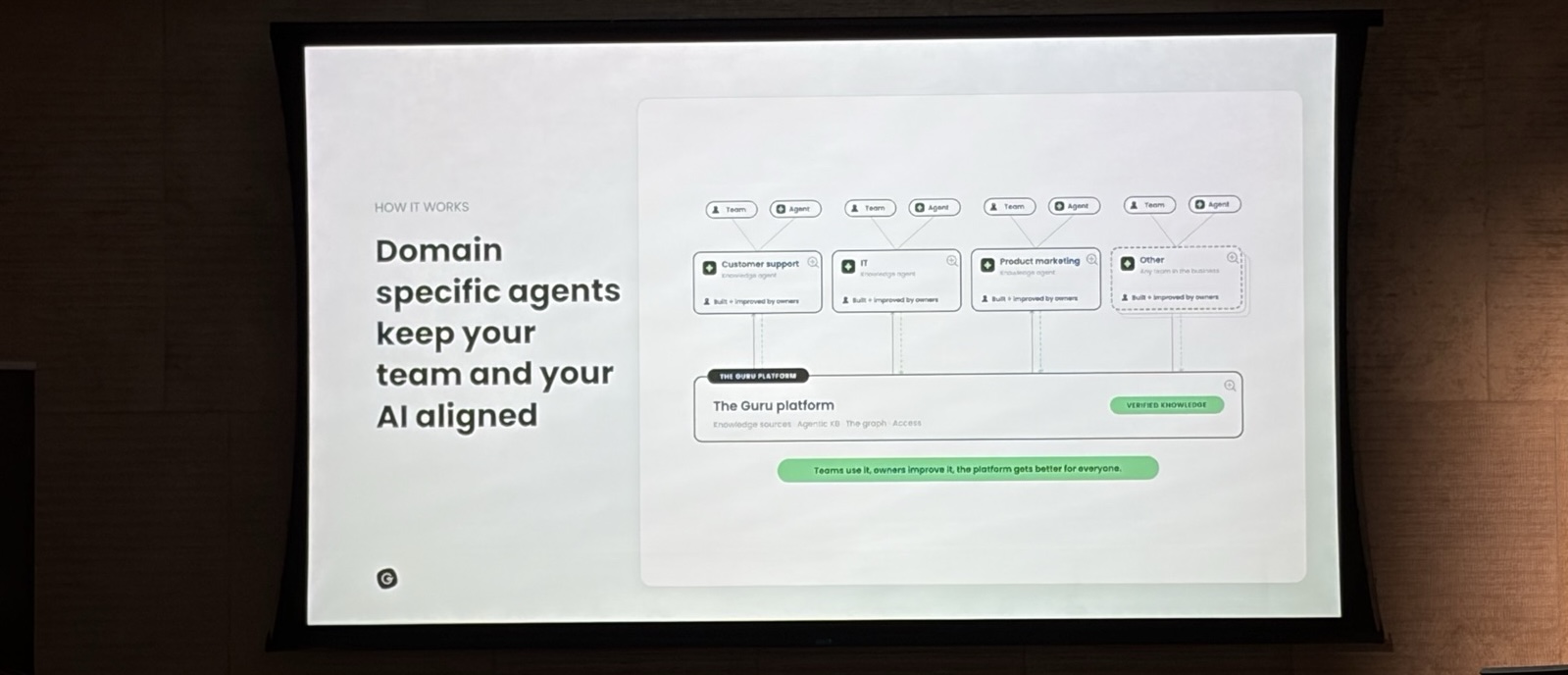
Guru wants to be that treatment plant, sitting between your raw knowledge (meeting recordings, SharePoint, Slack threads) and the AI tools that use it (Copilot, Claude, ChatGPT, or the agents you build yourself).
The part I found most interesting is the upkeep.
Three months after you launch your AI project, your products, processes, or people have changed, and the documents you fed it are still describing the old world.
Guru handles this with a loop run by what they call knowledge agents. Rick’s example: a subject matter expert says in a recorded meeting that you’re launching in Germany on a specific date. Nobody writes it down. The knowledge agent finds it, drafts a launch plan, and routes it back to that expert for approval.
Now customer support can answer “when are you available in Germany?” correctly.
Each knowledge agent pairs the humans who decide how things work (how refunds are handled, how the product is priced) with the raw material, and keeps that knowledge accurate as things change.
Five Lessons from the Rebuild
After the primer on Guru, Rick zoomed out and shared five things they learned along the way.
Being Early Is a Bet
“Being early is a bet, not a free advantage.”
When you decide what problem matters, you are looking over the horizon and betting that the world will move there. Boomi bet on SaaS. If SaaS had turned out to be a fad (as Larry Ellison once suggested), Boomi would have built technology that didn’t matter.
Guru’s bet on accuracy took a while to pay off. In 2024 and a good part of 2025, a lot of companies were still setting up their first ChatGPT accounts. They didn’t know about the accuracy problem yet, because they hadn’t run into it.
Now the conversation is different. As Rick put it, customers come to Guru saying:
“We hooked our AI straight into SharePoint and it’s a complete disaster.”
Cost is following the same pattern: customers only feel it after rollout.
Rick shared that going into 2026, Guru tried “token maxing”, where whoever burned the most tokens was seen as doing the best job.
People figured out how to put jobs on a schedule and burn tokens, and the budget was gone.
Now the pendulum has swung back hard to efficiency: a mix of models for different jobs, and less wasteful context.
An AI that fans out across ten different systems to piece together one answer burns a lot of tokens. Accuracy and cost are what Rick called “day two problems”, and they only become top priorities once a company has actually rolled something out.
Don’t Build on Model Shortcomings
Rick wasn’t the first to say this (Sam Altman says a version of it often):
Do not build products that are based on shortcomings in a particular model.
According to Rick, a new model now comes out about every eleven days on average, and each one is more capable than the last. However capable they get, they still won’t know anything about your company, because your company is not (and should not be) public training data.
His example was another knowledge agent loop. A product decision gets made in a Slack channel, but the written spec says something different.
The knowledge agent notices the conflict, drafts an update to the spec, and sends it to the product manager for approval. When Guru tried that loop in late 2025, it wasn’t reliable enough to run.
Around April or May of 2026, a new crop of models made it work in a reliable, repeatable way.
A Good Brand Can Work Against You
The better known your brand is for what you used to do, the harder it is to be known for what you do now.
Rick admitted this is a real challenge for Guru, and pointed out it’s solvable: nobody thinks of Netflix as the company that mails DVDs anymore.
The lesson that surprised me here was about existing customers. The usual advice from VCs is that selling to your existing customers is easier than selling to new prospects.
Rick’s experience is that this isn’t always true right now. The people who brought Guru in ten years ago are often not the people making AI decisions today, since those decisions get made in different parts of the business.
So Guru treats long-time customers still using “old Guru” the same way it treats prospects who have never heard of them, and starts from first principles.
Adoption: One Workflow, One Outcome, One Squad
If you look at a typical company’s AI rollout, Rick said, it looks something like this: about 5% of people (and that might be generous) use AI all the time, show up with ideas, and share the cool things they built.
Those are your AI exemplars. Then there’s a large group that logged in once or twice. Being “monthly active” is not the same as transforming your business with AI.
Part of the problem is how AI gets positioned: as something that does everything for everyone, all at once, as soon as you hand everybody a chat box. Anyone who has tried it knows that is not how it works.
His advice was to pick one workflow, one outcome, and one squad. The squad can be a single person, as long as you pair an AI exemplar with someone who knows the process cold.
This lines up with what we wrote about in Finding the Right Problems to Solve with AI (start with real friction, prefer small and measurable wins) and in AI for Small Business Starts With People , where one engineering team we work with introduced AI one workflow at a time.
Pricing for Work Done
The last lesson is still being figured out. SaaS was built on per-seat pricing, which everybody understands and knows how to budget for.
AI is pushing pricing toward paying for work done.
Rick believes that can be a fair value exchange, as long as there’s transparency: the AI must ledger its work.
If you hired a consultant and they sent you an invoice with no timesheet and no list of what they did, you wouldn’t pay it. The same should apply to AI.
What Comes Next: Personal Agents
Rick closed with what he thinks comes next. There are a million things coming around AI, but he picked one: the rise of the personal agent.
This is a specific type of AI whose sole job is to obsessively learn about you, closer to a chief of staff or a personal assistant than to ChatGPT.
The first example to really take off was OpenClaw , an open-source personal agent built by Peter Steinberger that blew up at the beginning of 2026.
OpenClaw and its peers are personal tools, but Rick said the workplace versions are already arriving. Microsoft announced Autopilot (originally called Scout , built on top of OpenClaw), Meta announced an enterprise platform for its Muse agent, and, the week before the conference, OpenAI announced Dots , its take on the idea for work.
The mental model he offered was the most useful part for me: copilots (like the chat in Claude or ChatGPT) work as you, while personal agents work for you. They have their own identity, their own tools, and their own email address. When they send an email, they send it as themselves.
Rick expects these agents to show up everywhere inside the workplace, and to be both wonderful and incredibly chaotic.
Picture every employee in your company with at least one agent that exists only to help them.
That creates room for new categories: control planes for security and governance, observability tools to understand what these agents are doing and correct them when they get it wrong, and (in Guru’s case) a place for what an agent learns about how you work.
If that memory is only stored locally, it stays silent and goes stale, and it never makes it into how the company actually works.
Through all of this, accountability and judgment remain human.
When an AI does something on your behalf, the accountability is still yours. That will shape a lot of decisions about how we design, scope, and manage agents.
Conclusion
In this article, I shared Rick Nucci’s talk at 1682 about Guru’s SaaS reckoning: why accuracy matters more than access, five lessons from rebuilding a SaaS company for AI, and why personal agents are next.
One idea from his talk stuck with me.
Rick showed a chart from Thomas Friedman’s 2016 book Thank You for Being Late, where technology moves faster than people’s ability to adapt to it.
That was true ten years ago, and it’s even more true now. What AI can do is still limited by how fast people can adapt to it, which is why the “one workflow, one outcome, one squad” advice resonated with me the most.
Not sure which workflow to start with? In our free webinar on October 22, we’ll show how small teams can roll out Claude safely, one workflow at a time: Claude for Small Business: Safe, Simple, and Actually Useful .